
If you’re a leader in the defense sector, you are not evaluating whether AI matters anymore. The question now is how to deploy it in ways that measurably increase mission effectiveness and efficiency without introducing unacceptable operational risk.
Agentic AI represents the next stage of AI adoption for the defense sector. Unlike isolated AI tools that generate outputs, agentic systems coordinate multiple models, data sources, and enterprise tools to plan tasks, take actions, verify results, and adapt within defined boundaries. Properly governed, these systems can execute repeatable workflow steps at scale while keeping humans in control of consequential decisions.
Deltek’s Federal Artificial Intelligence Landscape, 2026–2028 executive summary signals what many defense leaders already see internally. Agencies are moving from experimentation to scaling, with generative and agentic AI increasingly viewed as force multipliers in an environment shaped by workforce constraints, operational tempo, and modernization pressure.
The budget envionment signals long-term commitment
As a decision maker, you track alignment between strategy and funding. The Department of Defense FY 2026 request includes $13.4 billion dedicated to autonomy and autonomous systems, according to DefenseScoop.
Although mostly dedicated to autonomous flying capabilities, that level of investment indicates that autonomy is programmatic. Autonomy at scale depends on intelligent orchestration across systems. Agentic AI architectures can provide that orchestration layer by coordinating tools, workflows, and data environments.
DoD budget briefing language reinforces this direction by describing autonomy software as an enabling capability that allows systems to operate together with a central coordinating layer, as described in the DoD FY 2026 budget briefing transcript.
Federal governance direction supports responsible acceleration
AI deployment in defense environments must align with federal governance expectations. OMB Memo M-25-21 emphasizes accelerating federal AI use while reinforcing innovation, governance, and public trust requirements, as published by the White House.
For defense leaders, this creates a dual mandate:
- Accelerate adoption where operational value is clear
- Maintain rigorous governance, risk management, and auditability
Agentic AI systems can support this mandate if deployed within defined control boundaries and with transparent logging, traceability, and human oversight.
Enterprise agents and defense modernization
Defense strategy materials explicitly reference enterprise agents as mechanisms to transform internal workflows and improve mission execution, in the Department’s AI strategy document.
For decision makers, this is not about replacing personnel, but about increasing throughput in high-volume, rule-bound processes that currently constrain mission velocity.
Where agentic AI can deliver immediate impact
Cyber operations and threat response
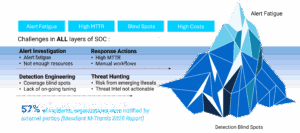
Operational cyber teams operate under sustained alert pressure. Agentic systems can triage events, correlate telemetry across tools, draft recommended responses aligned to policy, and update tracking systems. Human approval remains required for high-impact remediation actions.
This approach aligns with federal expectations for accelerating AI while maintaining governance controls, as defined in OMB M-25-21.
For leaders overseeing cyber readiness, the measurable value is reduced triage backlog and faster response cycle times.
Agentic Security in Action: BlueDome for Defense Operations
One example of how this moves beyond simple LLM use cases is BlueDome. BlueDome is not just a chatbot layered onto security tools. It is an agentic security operations platform that orchestrates detection, investigation, enrichment, and response workflows across your existing environment. Instead of generating a static answer, BlueDome can correlate alerts, pull contextual telemetry, validate against policy, recommend actions, and execute approved remediation steps within defined guardrails. This is the difference between language generation and operational execution. For defense agencies, that distinction matters. Agentic systems like BlueDome are built to function inside structured security environments, integrate with existing SOC tools, and maintain traceability, logging, and human oversight. The result is measurable reduction in triage time, improved analyst throughput, and mission-aligned automation that extends beyond a single model interface.
Logistics and readiness workflows
Maintenance documentation, supply reconciliation, approvals generation, and system updates are workflow-heavy processes. Agentic systems can execute defined steps, flag anomalies, and generate required artifacts for review.
Budget language around autonomy software as an enabling layer reinforces that coordination and orchestration are now core to modernization, as noted in the transcript.
For logistics leaders, the advantage is improved availability driven by reduced administrative lag.
Acquisition and compliance throughput
Defense agencies operate within highly structured acquisition environments. Agentic AI can support drafting requirements, conducting structured document review, performing compliance cross-checks, and tracking milestone artifacts.
Industry research indicates that agentic systems can redefine procurement performance when paired with governance and measurable outcomes, as discussed by McKinsey.
Market signals reinforce strategic timing
Deltek’s analysis estimates that $5.6 billion is allocated to federal prime AI contract obligations across FY 2022 through FY 2024, based on conservative identification methodologies outlined.
The report highlights that identifiable AI spending remains concentrated among the largest agencies. For defense leaders, this signals both maturity in select departments and an opportunity to close capability gaps in others.
Overlay this with the FY 2026 request of $13.4 billion for autonomy and autonomous systems, as reported by DefenseScoop, and the trajectory is unmistakable.
Autonomy and AI-enabled systems are moving deeper into sustained defense investment portfolios.
Governance, risk, and auditability must scale with capability
As defense decision makers, your threshold for risk is different from the commercial sector. Agentic AI expands automation scope and therefore expands the risk surface.
The NIST AI Risk Management Framework provides structured lifecycle guidance for trustworthy AI systems. OMB’s M-25-21 memo reinforces federal expectations around AI governance, transparency, and responsible scaling, as published by the White House.
For defense leaders, scaling agentic AI requires:
- Defined human decision thresholds
- Full logging of prompts, data access, and tool execution
- Strict identity and least-privilege controls
- Continuous monitoring and validation
If an agent’s actions cannot be constrained, traced, reviewed, and justified, it should not operate at mission scale.
Strategic implication for defense leaders
Agentic AI is not a future capability discussion. Budget alignment, policy direction, and enterprise strategy all point toward accelerated adoption.
For defense decision makers, the focus should be on disciplined implementation:
- Start with bounded enterprise workflows
- Analyze opportunities for introduction of Agentic AI
- Measure cycle-time and backlog reduction
- Embed governance from day one
- Scale only when controls are proven
The opportunity presented by Agentic AI encompasses many areas of mission capacity expansion. This expansion must be achieved through structured, secure automation aligned to defense priorities.
If your agency is evaluating how to move from isolated AI tools to mission-ready agentic systems, FedTec can help you assess, architect, and operationalize AI within your existing security, ITSM, and modernization frameworks. From governed pilot programs to enterprise-scale deployment, our focus is simple: measurable mission impact with uncompromised security and compliance.
Connect with FedTec to explore how agentic AI can be implemented responsibly and at scale inside your organization.